

The elements and principles of art are the following:
Line, the path of a point moving through space
Pattern, the repetition or reccurrence of a design element
Shape Form, shape implies spatial form and is usually perceived as 2D, form has depth, length, and width is usually is perceived as 3D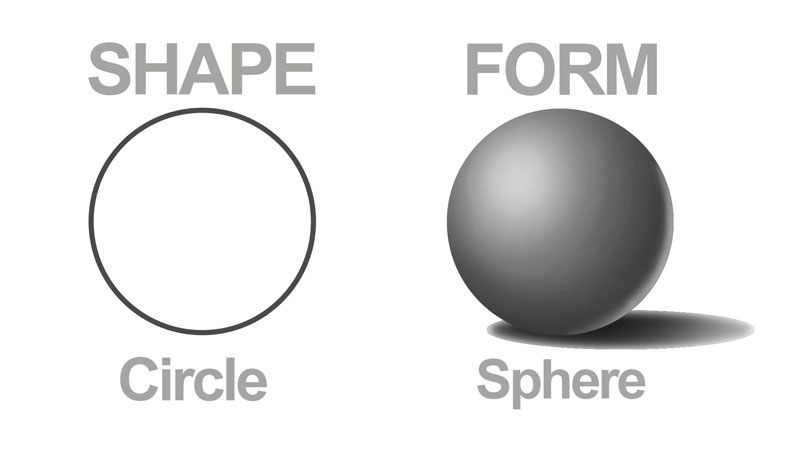
Rhythm and Movement, refers to the suggestion of movement through the use of visual elements

Color, comes from the three primaries and black and white
Proportion and Scale, the size relationship of parts to a whole and one to another, scale is relating size to a contrast
Value, the relative lightness and darkness of a color
Balance, the impression of equilibrium
Texture, the tactile qualities of a surface.

Unity, all of the components of a piece perceived as a whole

Space, organized perspective

Emphasis, the created center of interest
:max_bytes(150000):strip_icc()/103860482-56a03d613df78cafdaa09dc5.jpg)
Squash and Stretch, the principle of applying a contrasting change of shape—from a squash pose to a stretch pose or vice versa—to give a feeling of fleshiness, flexibility, and life in animation.
Anticipation, pose or drawing is a preparation for the main action of an animated scene, as distinct from the action and the reaction.

Staging, to lead the viewers eye to where the action will occur so that they do not miss anything.

Straight Ahead, Action in hand drawn animation is when the animator starts at the first drawing in a scene and then draws all of the subsequent frames until he reaches the end of the scene.

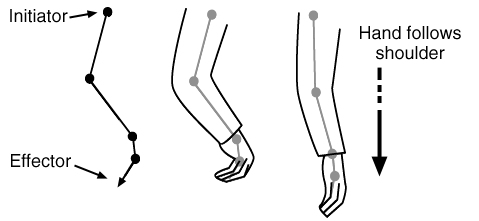
Follow Through and Overlapping Action are closely related techniques which, when applied to animation, can help to render movement more realistically, and help to give the impression that characters follow the laws of physics.
Slow in Slow out, As action starts, we have more drawings near the starting pose, one or two in the middle, and more drawings near the next pose. Fewer drawings make the action faster and more drawings make the action slower. Slow-ins and slow-outs soften the action, making it more life-like. For a gag action, we may omit some slow-out or slow-ins for shock appeal or the surprise element. This will give more snap to the scene.

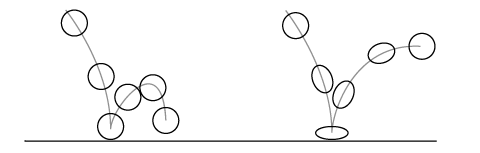
Arcs, All actions, with few exceptions (such as the animation of a mechanical device), follow an arc or slightly circular path. This is especially true of the human figure and the action of animals. Arcs give animation a more natural action and better flow. Think of natural movements in the terms of a pendulum swinging. All arm movement, head turns and even eye movements are executed on an arcs.

Secondary Action, his action adds to and enriches the main action and adds more dimension to the character animation, supplementing and/or re-enforcing the main action. Example: A character is angrily walking toward another character. The walk is forceful, aggressive, and forward leaning. The leg action is just short of a stomping walk. The secondary action is a few strong gestures of the arms working with the walk. Also, the possibility of dialogue being delivered at the same time with tilts and turns of the head to accentuate the walk and dialogue, but not so much as to distract from the walk action. All of these actions should work together in support of one another. Think of the walk as the primary action and arm swings, head bounce and all other actions of the body as secondary or supporting action.

Timing, Expertise in timing comes best with experience and personal experimentation, using the trial and error method in refining technique. The basics are: more drawings between poses slow and smooth the action. Fewer drawings make the action faster and crisper. A variety of slow and fast timing within a scene adds texture and interest to the movement. Most animation is done on twos (one drawing photographed on two frames of film) or on ones (one drawing photographed on each frame of film). Twos are used most of the time, and ones are used during camera moves such as trucks, pans and occasionally for subtle and quick dialogue animation. Also, there is timing in the acting of a character to establish mood, emotion, and reaction to another character or to a situation. Studying movement of actors and performers on stage and in films is useful when animating human or animal characters. This frame by frame examination of film footage will aid you in understanding timing for animation. This is a great way to learn from the others.

Exaggeration, Exaggeration is not extreme distortion of a drawing or extremely broad, violent action all the time. Its like a caricature of facial features, expressions, poses, attitudes and actions. Action traced from live action film can be accurate, but stiff and mechanical. In feature animation, a character must move more broadly to look natural. The same is true of facial expressions, but the action should not be as broad as in a short cartoon style. Exaggeration in a walk or an eye movement or even a head turn will give your film more appeal. Use good taste and common sense to keep from becoming too theatrical and excessively animated.

Solid Drawing, The basic principles of drawing form, weight, volume solidity and the illusion of three dimension apply to animation as it does to academic drawing. The way you draw cartoons, you draw in the classical sense, using pencil sketches and drawings for reproduction of life. You transform these into color and movement giving the characters the illusion of three-and four-dimensional life. Three dimensional is movement in space. The fourth dimension is movement in time.

Appeal, A live performer has charisma. An animated character has appeal. Appealing animation does not mean just being cute and cuddly. All characters have to have appeal whether they are heroic, villainous, comic or cute. Appeal, as you will use it, includes an easy to read design, clear drawing, and personality development that will capture and involve the audience’s interest. Early cartoons were basically a series of gags strung together on a main theme. Over the years, the artists have learned that to produce a feature there was a need for story continuity, character development and a higher quality of artwork throughout the entire production. Like all forms of story telling, the feature has to appeal to the mind as well as to the eye.


 Gabe's Blog for Animation Class